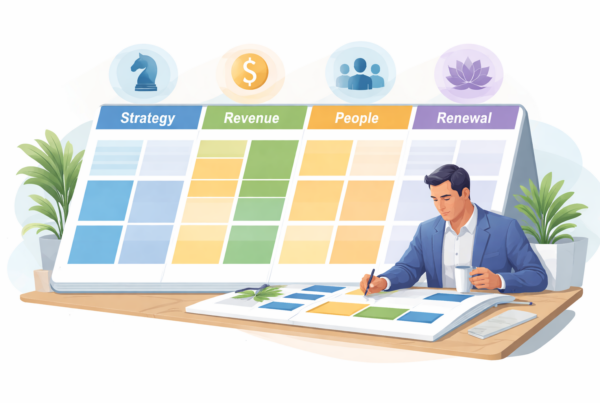

Business coaching can help a small-business owner make space for clearer decisions, priorities and follow-through. It does not guarantee revenue, hiring results, customer growth or a particular outcome.

Start with the decision that matters now
A coaching engagement is stronger when it begins with a defined question: which service to prioritise, how to make weekly planning more reliable, how to prepare for a leadership conversation or how to test an operational improvement. A specific question gives the owner, coach and any relevant team members a practical focus.
Write down the conditions around the decision as well: cash constraints, time available, people affected, information still needed and who has the authority to decide. This reduces the risk of treating coaching as a generic solution to every business problem.
What a coach can and cannot do
Coaching commonly provides structured questions, reflection, accountability and space to practise new leadership habits. Consulting commonly offers expert recommendations. Training commonly teaches a skill. An engagement may include more than one of these, but the roles should be clear from the outset.
A coach should not replace legal, financial, HR, tax, health or regulated professional advice. When the problem requires specialist analysis, compliance guidance or implementation expertise, involve the relevant professional.
Choose support carefully
- Clarify your need: describe the problem and the progress you would like to review, without assuming a particular business result.
- Ask about approach: understand how sessions work, how confidentiality is handled and whether the coach provides coaching, consulting, training or a combination.
- Check relevant experience: look for context that is useful to your situation, while avoiding the assumption that another client’s result predicts yours.
- Discuss practicalities: fees, time commitment, preparation, who attends, cancellation terms and review points should be clear.
- Test fit: a short fit conversation gives both sides an opportunity to decide whether the working relationship is appropriate.
Build an agreement that supports good work
Agree the purpose, scope, confidentiality, roles, session rhythm and how progress will be reviewed. If a partner, manager or sponsor is involved, be explicit about what can be shared and what remains confidential. The owner retains responsibility for decisions and actions.
Use a small number of measures that fit the actual question. For an operational project, this might include whether a new process was adopted, whether handoffs became clearer and what frontline feedback showed. Context matters: changing demand, staffing, market conditions and other initiatives can all affect results.
Make each session practical
Bring current information and a real decision. A coach may help you examine assumptions, identify options and decide what to test next. End with an observable action, an owner and a date for review. Keep a short record so insights do not disappear between meetings.
Hypothetical example: an owner wants to improve how enquiries are handled. They could map the current handoff, ask two staff members where delays occur, test a simple shared checklist for two weeks and review the experience. That is not a promise of increased sales; it is a disciplined way to learn before making a wider change.
Leadership and accountability
Many owners benefit from a regular place to examine priorities, delegation and difficult conversations. Accountability should be supportive and realistic, not pressure to pursue an unsuitable goal. If an action is repeatedly not happening, explore the obstacle: capacity, authority, clarity, confidence or a competing priority.
Review progress honestly
At agreed intervals, ask what changed, what evidence supports that view, what remains difficult and whether coaching is still the right support. Some progress may be behavioural or operational before it appears in a business measure. Equally, a business result may be influenced by many factors beyond coaching. A responsible review does not overstate cause and effect.
Frequently asked questions
Is business coaching right for every small business?
No. It can be useful when the owner needs structured reflection, accountability or leadership development. Specialist advice or implementation support may be more appropriate for other needs.
What should I bring to an introductory call?
Bring the question you want to address, relevant constraints and any expectations about format or scope. Use the conversation to understand fit rather than to expect a complete solution in one meeting.
How do I know whether coaching is working?
Use the review method agreed at the outset: completed actions, clearer decisions, relevant feedback or suitable operational measures. Reassess the scope if the work is not serving its purpose.
Considering small-business coaching? Book a free 15-minute fit call to discuss your current question and whether coaching is appropriate.