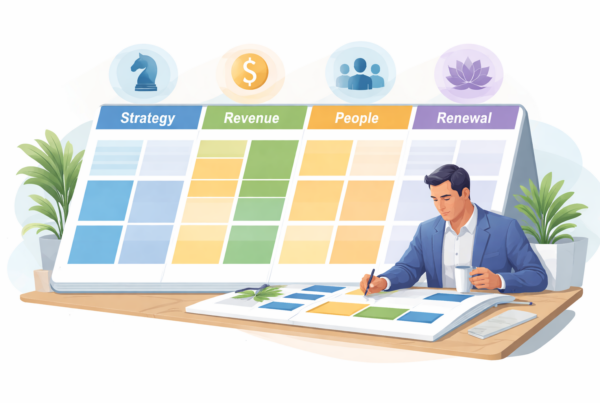

Business coaching can give an owner or leader structured space to think through decisions, priorities, accountability and leadership habits. It is not a guarantee of revenue, growth, funding or any particular business result.

What business coaching can support
A useful coaching engagement starts with a real challenge rather than a vague wish to “grow.” It might involve clarifying a decision, improving how priorities are set, preparing for a difficult conversation, creating a more workable planning rhythm, or developing leadership capability.
Coaching is usually most valuable when the client remains responsible for the decisions and implementation. A coach can offer questions, reflection, structure and accountability. If you need specialist technical advice, a consultant, accountant, lawyer, HR professional or industry expert may be the better fit.
Start with a defined question
Before looking for support, write down the question you want to work on. For example: “How should we decide which customer segment to focus on this quarter?” or “What needs to change in my weekly leadership routine so my team has clearer priorities?” A specific question gives both parties something practical to test.
It also helps to identify the constraints: the available time, people involved, information that is missing and decisions that cannot be delegated. These details make the first conversation more useful and prevent a coaching arrangement from becoming a collection of broad intentions.
How to choose a business coach
- Relevant context: Ask about experience with situations comparable to yours, without assuming a coach has a universal formula.
- Approach and credentials: Understand how sessions are structured, how the coach works with goals and what professional training or standards inform their practice.
- Coaching, consulting or training: Be clear about whether you want questions and accountability, recommendations and expertise, or skills instruction. Some engagements combine these; the roles should be explicit.
- References and evidence: Request relevant examples or references where clients have given permission. Treat results as context, not a prediction of what will happen for you.
- Practical fit: Discuss availability, fees, confidentiality, format and how progress will be reviewed. A short introductory conversation can help both sides decide whether the fit is right.
Agree purpose, roles and boundaries
Put the basics in writing. A clear agreement should cover the purpose of the work, frequency of sessions, confidentiality, who is involved, how decisions remain with the client and what each person will prepare between sessions. If an organisation is sponsoring coaching, address what can and cannot be shared with the sponsor.
It is equally important to name the boundaries. Coaching does not replace legal, financial, medical, mental-health or regulated professional advice. Agree early when a different specialist needs to be involved.
Use each session well
Bring a current decision, a piece of relevant information or a conversation you need to prepare for. State what would make the session worthwhile. Good questions may challenge an assumption, identify an overlooked stakeholder or reveal that a proposed action is too broad to begin.
End with a small, observable next step: who will do what, by when, and what evidence will show it happened. For example, rather than “improve communication,” a leader might schedule two short priority-setting conversations, ask the team what remains unclear, and review the answers at the next session.
Review progress without overstating cause
Review the engagement regularly. Look for changes you can observe, such as a clearer decision process, completed actions, feedback from relevant people or a more consistent meeting rhythm. Business outcomes are affected by many factors, so coaching should not be credited automatically for every change.
A useful review asks: What has changed? What remains difficult? What should be adjusted? And is this still the right type of support? That keeps the work grounded and gives you a sensible basis for continuing, changing scope or stopping.
Illustrative example: a pricing review
Hypothetical example: an owner is unsure whether to review pricing. In coaching, they could define the decision, identify which customer, cost and market information they need, decide who should be consulted and set a date to review the evidence. The coach does not determine the price or guarantee the outcome; the owner remains responsible for seeking any necessary financial or legal advice and making the decision.
When different support is better
Choose a specialist when the main need is expert analysis, compliance guidance, treatment, mediation or a technical implementation. Coaching can sit alongside specialist advice, but it should not be presented as a substitute for it.
Frequently asked questions
What is business coaching?
Business coaching is a structured professional conversation that can support an owner or leader to clarify priorities, explore options, make decisions and follow through on agreed actions.
How long should a coaching engagement last?
That depends on the question, scope and review points agreed at the outset. Decide how progress will be checked rather than assuming a fixed outcome or timeframe.
Will a coach tell me what to do?
It depends on the agreed role. Coaching commonly uses questions and accountability; consulting provides recommendations based on expertise. Clarify the distinction before starting.
Considering business coaching? Book a free 15-minute fit call to discuss the question you want to work on and whether this support is appropriate.