Design Your Ideal Week: A Time-Blocked Blueprint for High-Performing CEOs

If your calendar looks like a game of Tetris, you’re losing—back-to-back meetings, random “quick calls,” and a thin strip of “work time” that starts at 7:30 pm—you don’t have a time problem.

You have a leadership allocation problem.

Whether you like it or not, your calendar is the most honest document in your company. It tells the truth about what’s actually important. And in a lot of founder-led businesses, it tells the same story:

  • The CEO is the routing center.

  • The CEO is the pressure valve.

  • The CEO is the default solution.

That’s how you end up living in your inbox and meetings instead of spending time on strategy—the two things that don’t get solved by “being responsive.”

If you want help turning your current week into something you can actually lead from, book a quick 15-minute call here: https://calendly.com/joelzimelstern1/15min


The real problem: your week is being designed for you

Most CEOs don’t “choose” their schedule. They inherit it.

A client needs you. A team lead wants alignment. A partner wants an answer. A fire pops up. Another fire pops up. Someone says, “It’ll only take 10 minutes,” which is executive-speak for “this will metastasize.”

And because CEOs spend a huge amount of their working time in interactions (meetings, calls, ad hoc conversations), the calendar becomes the operating system of the role—whether it’s designed or not.

So here’s the shift:

Stop trying to “manage time.” Start designing your week around the outcomes only you can create.


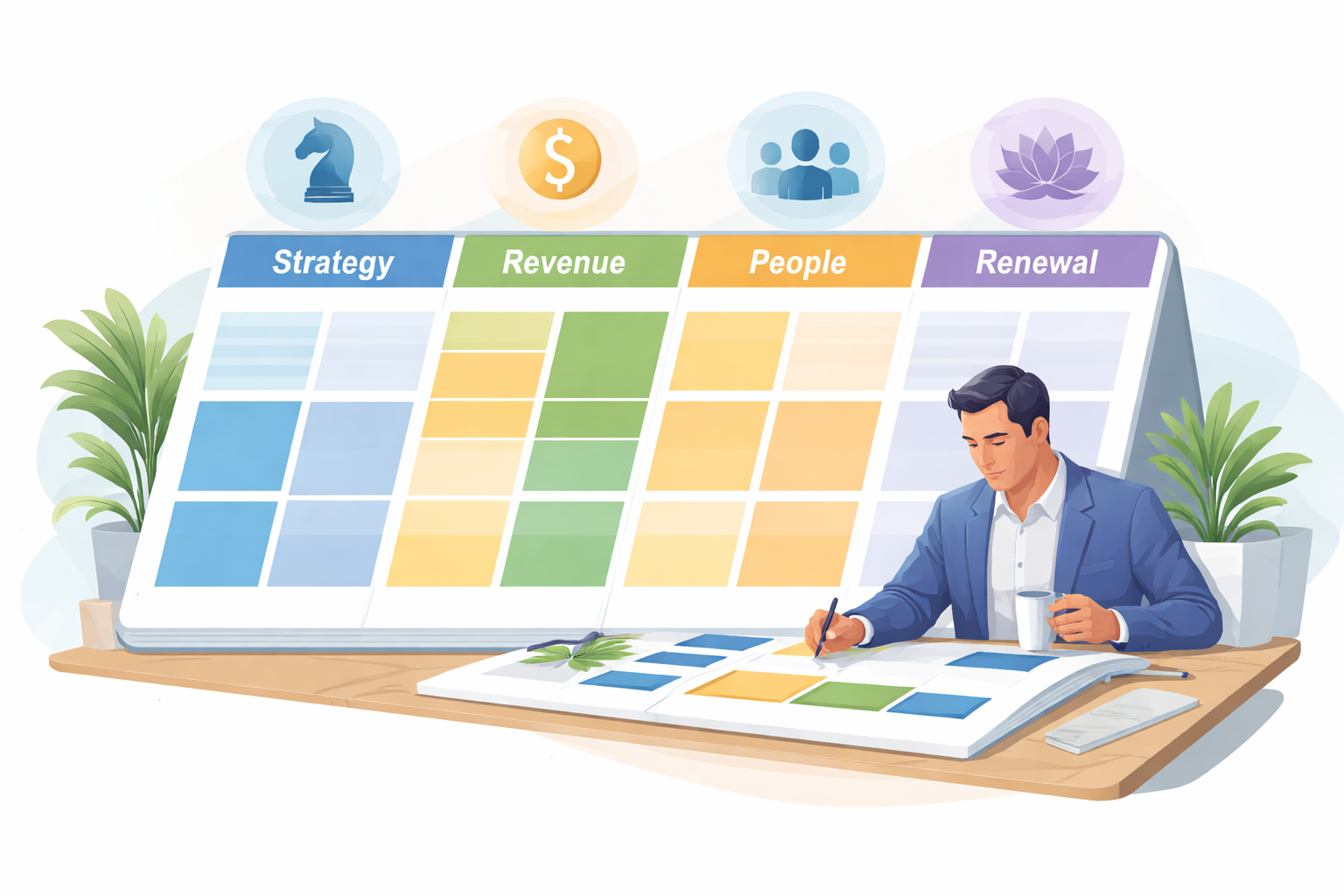
The four blocks of a CEO week (keep it simple, keep it real)

I like a framework that’s obvious enough to remember when your week goes sideways:

1) Strategy

This is the work that makes your business more valuable over time.

Strategy time looks like:

  • thinking without Slack open

  • clarifying priorities

  • solving the real constraint (not the loudest one)

  • positioning, pricing, offers, capacity, leverage

If strategyStrategyn I get to it,” it will always lose to whatever feels urgent.

2) Revenue

Revenue is oxygen. When it’s healthy, you can think clearly. When it’s not, everything becomes reactive.

Revenue time looks like:

  • pipeline review that leads to decisions

  • top-deal strategy Strategy: You actually move a few big rocks.

  • relationship building (clients, partners, referral sources)

  • marketing review that ends in one committed move, not ten ideas

3) People

This is the block most founders underfund, then wonder why they’re stuck.

People time looks like:

  • 1:1s with direct reports

  • coaching + feedback

  • hiring decisions

  • performance alignment and expectations

If you don’t invest time here, you pay for it later in rework, drama, and “why can’t they just…?”

4) Renewal

This isn’t spa-day energy. This is “your brain is the asset” reality.

Renewal is what protects your:

  • focus

  • patience

  • decision quality

  • ability to lead without snapping at someone because your third meeting ran long

And if you want a practical way to justify the time for renewal to your inner workaholic, CEO time research routinely shows how central routines and structure are to sustained leadership output.


What an Ideal Week actually is (and what it isn’t)

An Ideal Week isn’t a fantasy schedule where nobody needs you, and you get eight hours of deep work a day.

It’s simply a default structure that keeps the four blocks visible—and makes it harder for your week to get hijacked.

The method underneath it is time blocking: you give time to a job, then update as reality changes instead of abandoning the plan. Cal Newport’s version is blunt and effective: plan your work day with intention, then adjust when it gets hit.

Also worth saying: a lot of “ideal week” content out there is aimed at individual productivity. Helpful—but CEOs need something slightly different: a schedule that reflects how the business is run, not just how tasks get done.


A “Joel-style” example week for a 10–50 person firm (not a template—just a pattern)

This isn’t meant to be copied. It’s meant to show what “protected priorities” look like in the real world.

Monday: Align + decide

  • Strategy focus block (early): review metrics, assess constraints, set the week’s priorities

  • Leadership meeting: one meeting that actually clears obstacles instead of creating them

  • Revenue check-in: top deals, top risks, top actions

Monday is where you buy clarity. If you skip it, you pay interest all week.

Tuesday: Build

  • Deep work block: product/offer work, positioning, systems—the stuff you can’t do with 14 browser tabs and a meeting in 6 minutes

  • Hiring / recruiting (if you’re in growth mode): batching this prevents “we should hire” from becoming a six-month loop

Wednesday: People

  • 1:1 day (or half-day): direct reports, coaching, expectations, decisions

  • Culture touchpoint: You don’t need to be everywhere, but you do need a consistent presence

Thursday: Revenue

  • Pipeline block: not “reviewing the CRM,” but making decisions and moving deals forward

  • Partner/client development: the relationship work that prevents Q3 panic

Friday: Review + protect next week

  • Decision review: close loops, delegate, kill low-value commitments

  • Calendar lock: protect next week’s Strategy/Revenue/People/Renewal blocks before your schedule turns into a public park

If you do nothing else, do Friday. It’s where Ideal Weeks survive.


The hidden leak: meetings expand to fill your leadership

Here’s a simple exercise that changes how you schedule:

Before you accept a meeting, ask:

“What’s the cost of having five salaries in a room for 60 minutes—and what outcome are we buying?”

HBR literally published a meeting cost calculator because most leaders underestimate the cost of “just a quick sync.”

This isn’t about being anti-meeting. Meetings can be great. It’s about being an anti-default meeting—the kind that exists because nobody redesigned the system.


Guardrails that keep your calendar from getting eaten alive

Your Ideal Week won’t fail because you didn’t design it.

It will fail because you didn’t defend it.

Here are guardrails that actually hold in founder-led businesses.

1) Two meeting windows per day (max)

Pick windows (for example, late morning and early afternoon). Outside those windows, you’re in focus blocks, prep, thinking, or recovery.

You don’t need a perfect system—you need a predictable one.

2) Stop starting meetings on the hour

Build micro-buffers automatically.

  • default meetings to 25 / 50 minutes

  • start at:05 or:10

It’s a small change that reduces the “my day is one continuous meeting” feeling.

3) Office hours for ad hoc needs

A lot of “quick questions” aren’t urgent. They’re just uncontained.

Create a recurring block: CEO Office Hours (two times a week). People can bring issues there instead of peppering your whole week.

4) Delegation rule: “Bring me options, not problems.”

If someone needs your decision, require:

  • context in 5 bullets

  • 2–3 options

  • their recommendation

This one habit reduces your calendar load fast because it trains the organization to think, not just escalate.

5) Communication boundary: no-ping after 6 pm (or choose your line)

If you want Renewal to exist, you need a boundary that’s clear enough to follow.

A simple rule:

  • No internal pings after 6 pm unless it’s truly urgent

  • define urgent (delivery blocked, client fire, security, revenue at risk)

Most teams can handle this. The bigger challenge is the CEO’s own reflex to stay available.


Three phrases that protect your focus without sounding like a jerk

Use these verbatim if you want:

  1. “I’m heads-down on strategyStrategyrning. Can you send me the decision in one paragraph with your recommendation?”

  2. “I can do Tuesday 11–12 or Thursday 1–2. If neither works, propose two alternatives inside my meeting windows.”

  3. “I’m not the right owner for this. Who on the team can decide—and what support do they need?”

The point isn’t to be rigid. The point is to stop making your availability the company’s strategy. Strategy doesn’t have an EA; here’s how you still enforce this.

You don’t need an executive assistant to protect your calendar. You need a process.

Try this:

  • Create a single scheduling rule doc (one page)

  • Put meeting windows on repeat

  • Turn focus blocks into “busy” time

  • Route scheduling through one place (Ops lead, Chief of Staff type, or even a shared policy)

And if you’re thinking, “This won’t work—people will still book over it,” then we’ve found the real issue: the company believes your time is communal property.

That’s fixable. It just takes a few hard resets and consistent follow-through.


A quick “before vs after” you can sanity-check against your own week

Before (common):

  • 9–5 booked solid

  • strategy at night

  • random 1:1s pushed repeatedly

  • constant context switching

  • You’re “busy,” but the business feels stuck

After (what we’re aiming for):

  • 2–3 protected focus blocks each week

  • One real revenue block that moves deals

  • 1:1s that happen on schedule

  • meeting windows (so your day has edges)

  • renewal that isn’t optional

That’s not perfection. That’s leadership with traction.

If you want, I’ll help you get there quickly. Book a 15-minute redesign call here: https://calendly.com/joelzimelstern1/15min


How to redesign your week in one hour (the no-drama version)

  1. Look at the last two weeks of your calendar
    Circle what was truly Strategy, Revenue, People, Renewal.

  2. Find the missing block
    Whatever’s missing is why you’re stuck. (It’s usually Strategy or People.)

  3. Install 4–8 non-negotiable recurring blocks
    Not 20. Start small. Make them real.

  4. Add guardrails
    Meeting windows, buffers, office hours, and delegation rules.

  5. Lock next week every Friday
    This is the habit that keeps the whole thing from dissolving.


The quiet truth: your calendar trains your team

Your team learns what matters by watching what gets protected.

If Strategy is movable, it becomes optional in the culture.

If 1:1s are always bumped, leadership becomes “when convenient.”

If you respond instantly at 10:30 pm, you’ve trained the organization to avoid thinking and wait for you.

None of this requires a dramatic overhaul. It requires designing a default week—and defending it as if it’s the job, because it is.

Want me to do this with you?

Send nothing. Explain nothing. Just book the 15-minute call, and we’ll work off your real calendar: https://calendly.com/joelzimelstern1/15min


Joel Zimelstern

Joel Zimelstern

I use my leadership skills to empower others and help clear the way for them to become the best version of themselves, and in doing so, I create opportunities for growth and fulfilment.