If you’ve ever thought, “I know I need support… I’m just not sure what kind,” you’re not alone.
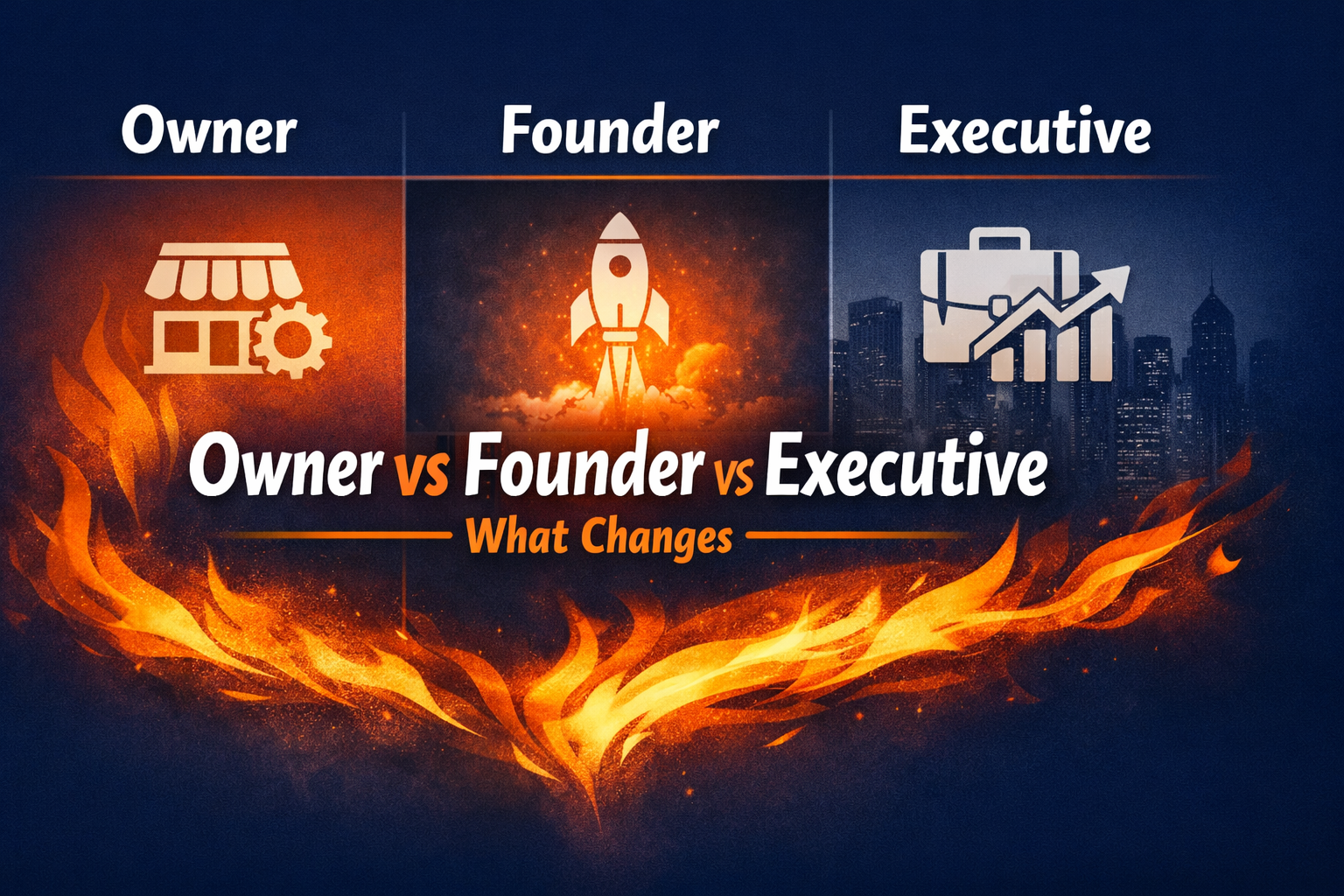
“Business coaching” is a broad term—but the reality is this: business coaching for small business owners vs founders vs executives changes based on what your role demands, what pressure you carry, and what progress would be useful within an agreed review period.
When you choose the wrong type of coaching, it can feel frustrating fast:
-
You talk about mindset when you needed a system
-
You brainstorm a strategy when you need execution discipline
-
You get tactics when you need alignment and influence
-
You keep “doing more” when you need leverage
If you want help identifying your lane (owner, founder, executive, or a blend), you’re welcome to book a free 15-minute fit call.
Book a free 15-minute fit call: Choose a time for a free fit call
Key takeaways
-
Small business owners usually need consistency: profitable offers, reliable sales, smoother delivery, and less owner-dependence.
-
Founders usually need scaling decisions: hiring, role clarity, execution cadence, and leadership under uncertainty.
-
Executives usually need leverage: alignment, influence, decision quality, and leading leaders.
In this article
-
Three role-reflection prompts
-
At-a-glance comparison
-
Coaching for small business owners
-
Coaching for founders
-
Coaching for executives
-
Overlaps and transitions (where people get stuck)
-
How to choose the right coach
-
FAQ
Three role-reflection prompts
Pick the statement that’s most true right now:
-
A) Owner mode: “I’m essential to everything. If I step away, things slow down.”
-
B) Founder mode: “We’re building and scaling fast; the business changes every quarter.”
-
C) Executive mode: “Results depend on alignment across people and teams I don’t directly control.”
You can be more than one. Founder-CEO is a common blend. Owner-to-CEO transition is another.
At-a-glance: what changes by role
These are illustrative themes, not fixed categories or a diagnostic assessment. Roles overlap, and timing and measures should reflect the actual situation.
If the full table is not visible, scroll it sideways to compare all four columns.
| Dimension | Small Business Owner | Founder | Executive |
|---|---|---|---|
| Primary objective | Stability + profitability + time back | Prove + grow + scale | Align + lead + deliver outcomes |
| Biggest constraint | Capacity + cash flow + owner-dependence | Uncertainty + speed + complexity | Stakeholders + competing priorities |
| Coaching focus | Systems, execution, fundamentals | Scaling structure + decisions | Influence, leverage, leadership impact |
| Success metrics | Margin, cash, lead flow, and delivery consistency | Traction, retention, execution rhythm | KPIs/OKRs, alignment, bench strength |
A guiding principle I bring into every engagement: we don’t chase “more effort.” We build a clearer path. The aim is to clarify responsibilities and useful next steps, then review what changes.
1) Coaching for small business owners: make the business less dependent on you
If you want the simplest view of what this looks like in practice, start here:
Vancouver business coaching: business coaching in Vancouver
You’re probably in this bucket if…
-
You’re wearing too many hats, and your calendar is the control tower
-
Revenue might be “okay,” but profit and cash flow feel unpredictable
-
Delegation turns into rework (or you take it back)
-
You’re leading by interruption: texts, Slack messages, “quick questions,” mini-crises
What changes in coaching here
Owner coaching is often about stabilizing before scaling. The goal is to reduce friction and owner-dependence by building a simple operating rhythm:
-
A weekly cadence (priorities + review) so problems don’t explode midweek
-
A simple scorecard (a few numbers that truly matter)
-
Delegation agreements (outcomes, not tasks)
-
Delivery systems (so quality isn’t dependent on heroics)
-
Pricing and capacity questions to review with appropriate financial expertise
A common trap
Owners try to solve a system’s problem with more effort. It works briefly—until the same fire returns.
Hypothetical scenario—not a client result
A service-based business owner is booked out, working 55–60 hours, and still feels anxious about cash. The first real wins aren’t “more marketing.” They’re tightening delivery, clarifying ownership, and aligning pricing/margins so growth doesn’t equal burnout.
Do this this week (owner)
-
Choose 3 numbers to review weekly (for example: leads, sales booked, cash balance/margin).
-
Delegate one outcome with a clear definition of “done.”
-
Schedule a 30-minute weekly review (even if it’s just you at first).
The 12-week management and sales masterclasses are currently paused. For current ways to work with Joel, compare coaching and workshop options and check confirmed event dates.
2) Coaching for founders: scale the business and evolve your role
Founders don’t just build a company. They build a company and a new version of themselves—often at the same time.
You’re probably in this bucket if…
-
The team is growing, but priorities keep shifting
-
You’re making high-stakes decisions with incomplete information
-
Hiring is constant, and role clarity is a moving target
-
You’re the bottleneck for decisions—not because you want to be, but because it “all routes through you.”
What changes in coaching here
Founder coaching may focus on decisions under uncertainty. The distinction is not absolute: owners and executives can face the same questions. Possible topics include:
-
Decision frameworks (what you decide, what others decide, and how)
-
Leadership team design (roles, responsibilities, handoffs)
-
Execution cadence (quarterly priorities + weekly check-ins)
-
Communication standards (how strategy and context flow through the org)
-
Founder capacity (protecting energy so you don’t burn the engine)
A common trap
Keeping critical context in your head and hoping people “get it.” At scale, context must become a system, not a person.
Hypothetical scenario—not a client result
A founder doubles headcount in 6 months. Work moves fast, but alignment collapses. Coaching targets decision rights, quarterly priorities, and communication rhythm—so speed stays clean and culture stays intact.
Do this this week (founder)
-
Write your next 90 days in one sentence: “By [date], we will achieve [outcome].”
-
Identify the 3 priorities that make that sentence true.
-
Clarify one decision area: who decides, who’s consulted, who executes.
If peer planning interests you, these programme pages provide background. Current availability, dates and terms need confirmation:
-
GrowthCLUB: GrowthCLUB planning workshop
-
ProfitCLUB: ProfitCLUB group coaching
3) Coaching for executives: increase leverage through alignment and influence
Executives rarely struggle because they don’t work hard. They struggle because complexity rises—and effort alone stops working.
If you want a deeper read on how this looks over the first 90 days, see:
Executive Coaching Vancouver: What to Expect in Your First 90 Days: executive coaching in Vancouver
You’re probably in this bucket if…
-
You’re delivering results, but it’s costing too much time, energy, or political capital.
-
You’re stuck in meetings, approvals, and rework
-
You’re leading leaders, and outcomes are inconsistent across teams
-
You need to influence without direct authority
What changes in coaching here
Executive coaching is about leverage. Your job isn’t doing more—it’s creating clarity and alignment so others can execute:
-
Stakeholder mapping + influence strategy
-
Leadership brand and executive presence (how you’re experienced in the room)
-
Decision cadence (what gets decided where, with what inputs)
-
Tough conversations (expectations, feedback, conflict, boundaries)
-
A 90-day leadership plan tied to measurable outcomes (KPIs/OKRs)
A common trap
Trying to outwork complexity. The faster path is typically better decisions, clear standards, and stronger alignment.
Hypothetical scenario—not a client result
An executive has a strong team but constant cross-functional friction. Coaching centers on stakeholder alignment, decision forums, and communication precision—so execution doesn’t die in handoffs.
Do this this week (executive)
-
Name your top 3 outcomes for the next 90 days.
-
List 3 stakeholders who can accelerate or block each outcome.
-
Ask: “What does success look like to you?” Then write down the answer verbatim.
For more on executive support, see:
Executive coaching services: executive coaching services
Overlaps and transitions: where most people get stuck (and where growth happens)
Founder → CEO
If you spend most of your time finding/validating the model, founder coaching is the better fit. If you spend most of your time running and scaling the organization, executive coaching may be worth considering.
Owner → CEO
As your team grows, your role shifts from “doing” to setting standards, building managers, protecting focus, and reinforcing accountability.
If you’re in a transition and want a conversation about whether coaching fits your needs, you’re welcome to book a free 15-minute fit call.
Book a free 15-minute fit call: Choose a time for a free fit call.
How to choose the right coach (questions that actually help)
If you are deciding whether coaching is the right kind of support, compare a business coach with a consultant before reviewing the role-specific questions below.
If you’re an owner
-
Where are we leaking profit: pricing, delivery, overhead, or sales consistency?
-
What would “less owner-dependence” look like in 90 days?
If you’re a founder
-
Am I the bottleneck for decisions, hiring, or clarity?
-
What must I stop doing to reach the next stage?
If you’re an executive
-
Where do I lose leverage: priorities, people, or politics?
-
What behaviour change would have the biggest impact in 90 days?
If you’re also working through communication or team dynamics, the DISC assessment can provide discussion prompts, but does not establish capability or guarantee team performance:
DISC assessment
You can also see the full range of options here:
Coaching & Workshops: coaching and workshop options
FAQ
Can one coach work for owners, founders, and executives?
Yes—if the approach changes with the role. Different role, different playbook.
Is executive coaching only for large companies?
No. Executive complexity shows up anywhere stakeholder alignment matters—even in smaller teams.
What if I’m a founder-CEO?
You often need a blended approach: founder-level decisions plus an executive operating rhythm.
How fast should coaching results show up?
There is no universal timetable or guaranteed result. Agree a baseline and review points, then examine changes, costs and other influences before deciding whether to continue.
Bottom line
-
Owners need consistency: systems that protect profit, time, and delivery quality.
-
Founders need clean speed: decisions, structure, and cadence that scale.
-
Executives need leverage: alignment, influence, and decision quality that deliver outcomes.
If you’re ready to move from “I know I should” to a clear plan you can execute, let’s talk.
Book a free 15-minute fit call: Choose a time for a free fit call
Before starting coaching, agree scope, confidentiality and its limits, any sponsor reporting, fees and review arrangements. Coaching does not replace specialist advice. You can also apply for two weeks of free coaching; applications are reviewed personally and acceptance is not guaranteed.