
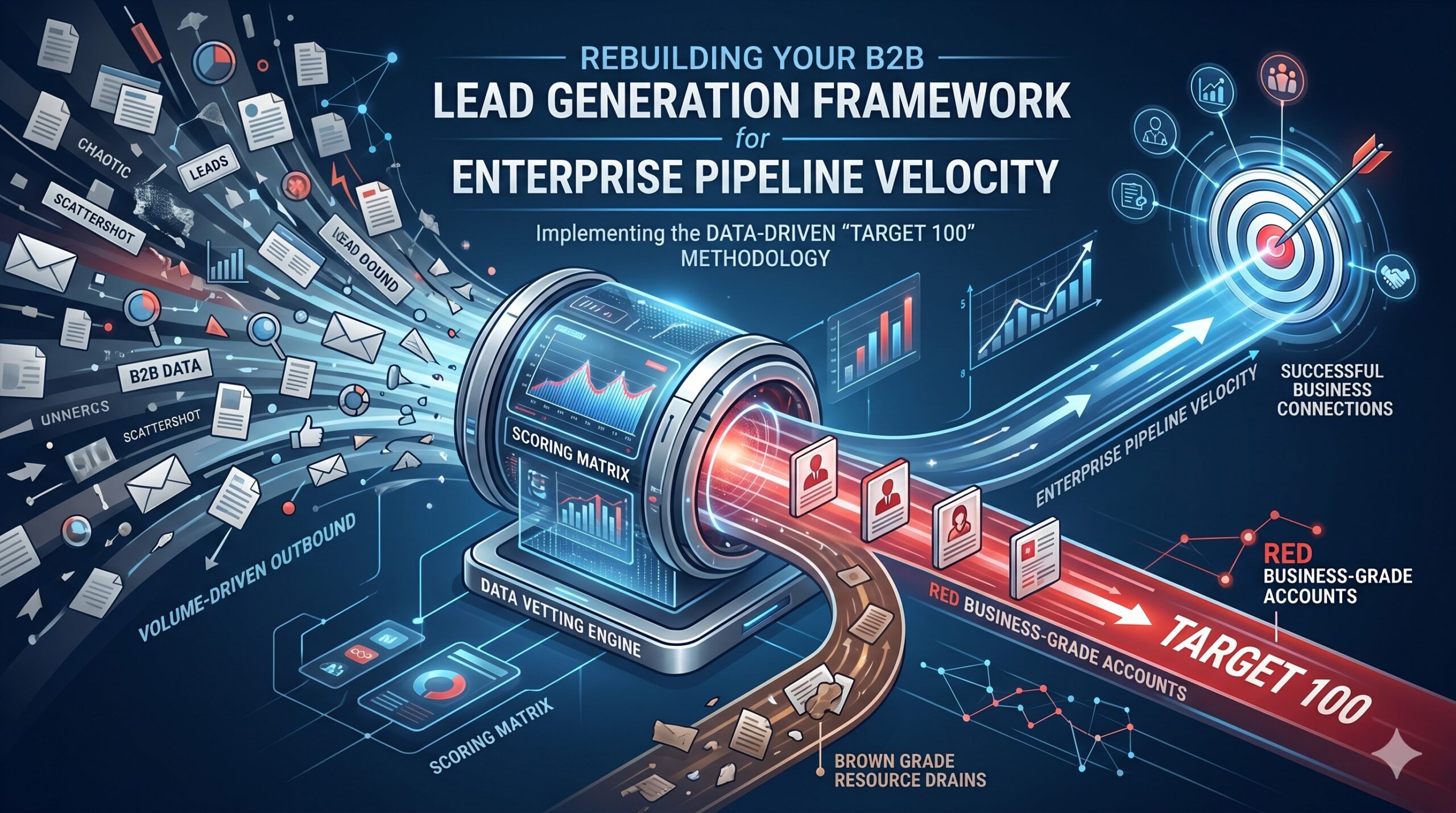
Rebuilding Your B2B Lead Generation Framework for Enterprise Pipeline Velocity
When a B2B pipeline slows down, the knee-jerk reaction is almost always the same: crank up the volume. Revenue leaders mandate higher activity quotas, buy massive email lists, and task their sales teams with blasting thousands of unvetted contacts through automated sequencing tools.
The result is entirely predictable. You get market fatigue, massive operational friction, plummeting conversion rates, and a sales team wasting its best cycles babysitting low-margin, high-maintenance clients.
True outbound efficiency isn’t about running a numbers game; it requires a structural pivot. To secure real velocity, you have to replace an anxious, scattershot marketing approach with a disciplined vetting architecture. As outlined in Salesforce’s enterprise lead framework, prioritizing high-value prospects over raw volume dramatically shortens the market discovery process. An elite model should act as a strict validation engine—filtering out resource-draining distractions long before your team ever picks up the phone.
The Anatomy of Outbound Failure: Chasing Leads Out of Structural Fear
Most corporate prospecting models suffer from a fundamental design flaw: they are built on anxiety rather than logical alignment. When your outbound lead-generation strategy is driven by short-term revenue panic, standards go out the window. You start classifying any business with an open budget as a viable opportunity.
This is where companies make major compromises, abandoning their core focus to chase low-value prospects that actively drag down operational efficiency.
The Real Cost of Low-Margin “Brown” Fit Clients
In a systematic client classification model, prospects exist on a very clear spectrum. On one end sit “Red” business-grade opportunities—accounts that mirror your ideal metrics, respect your expertise, and yield sustainable margins. On the opposite end are “Brown” grade clients.
Accepting or pursuing “Brown” grade accounts because you feel like “needs must” comes at a severe operational premium:
-
Margin Erosion: These accounts demand endless custom engineering, constant strategic hand-holding, and non-stop support, quickly wiping out the initial contract value.
-
Velocity Drag: They stall your pipeline metrics, bloat your sales cycles, and distract your best problem-solvers from hunting elite enterprise accounts.
-
Internal Friction: Chasing misaligned revenue fragments team morale and pulls your company away from owning specialized markets.
Ultimately, working with “Brown” businesses is driven entirely by fear, not by your corporate purpose.
💡 Is structural fear dictating your current pipeline strategy? If your outbound team is burning out on friction-heavy “Brown” accounts just to hit activity metrics, let’s run a brutal, objective diagnostic on your selection model. Schedule a 15-Minute Pipeline Evaluation to map out your escape from low-margin drag.
Realigning Sales Focus with Corporate Purpose and Profit
To break out of the low-margin trap, leadership must establish an objective gatekeeping structure. This means shifting your sales culture from a scattershot pursuit of the market to a disciplined focus on high-value targets.
Transitioning from a generalist footprint to a specialized domain authority reduces market resistance and creates a natural gravitational pull for elite accounts. When a company’s sales prospecting framework is rooted in logical profile alignment rather than short-term revenue panic, it can consistently protect its operational capacity and optimize returns on effort.
The Core Pillar: Moving Suspects Through the Validation Engine
An enterprise sales pipeline must function like an objective corporate interrogation system. Never assume a business is a qualified prospect just because it happens to be in the right industry vertical. Instead, targets must progress through a systematic “Suspect-to-Prospect” engine, where they are continuously vetted against empirical criteria.
[Raw Market Suspects]
|
v
+-----------------------------+
| Empirical Scoring Gate | <-- Purge the "Brown" time-wasting drains
+-----------------------------+
|
v
[Validated Target 100]
1. Fact-Based Profile Isolation Over Guesswork
The foundation of an elite customer profile validation model relies on cold, observable data points rather than sales optimism. The validation engine begins by evaluating foundational structural health metrics:
-
Capital Architecture: Look directly at their corporate structure, fiscal allocation choices, and public account health. Does the financial runway match a high-value implementation?
-
Operational Scale: Track headcount velocity, internal system complexity, and structural bottlenecks to see if they actually have the capacity to scale with you.
-
Market Mandate: Identify their documented strategic growth priorities and public leadership commitments to uncover immediate operational alignment.
2. The Scoring System That Filters Elite Targets
Before any outbound engagement begins, every suspect must pass through a strict parameter matrix. To implement this objectively by mapping your data against an established sales pipeline tracking framework, score every target on a 1–10 scale across five clear parameters:
-
Functional Fit: Do they face the exact, multi-faceted problems your specialized solution solves?
-
Authority Architecture: Is the internal reporting line clear, or is decision-making fragmented and ambiguous?
-
Resource Capacity: Do public financial disclosures indicate they have the capital allocation strategy required for an enterprise deal?
-
Change Agility: Does their corporate history show a willingness to adapt, or are they operationally rigid?
-
System Compatibility: Will their existing corporate framework integrate smoothly with your operational delivery model?
If a suspect cannot achieve a verified baseline score across these gates, immediately purge them from consideration.
The Subsurface Intelligence Checklist: Vetting Beyond the Balance Sheet
Standard list brokers provide superficial data: basic tech stacks, generic office numbers, and broad executive titles. Relying on this surface-level data ensures your outbound messaging sounds identical to every competitor. To minimize market resistance, a modern sales prospecting framework must look at subsurface research.
Extracting Hidden Signals From Financial Filings and Public Statements
To truly understand an enterprise target, skip the marketing brochures and pull data directly from compliance clearinghouses. For US-based targets, cross-reference data using the SEC’s EDGAR database search, or use Sedar+ continuous disclosure listings for Canadian organizations. Reviewing these balance sheets reveals an organization’s actual strategic priorities:
-
Capital Deployment Shifts: An increase in R&D or operational restructuring budgets indicates an immediate need for external expertise and structural optimization. This data can be contextualized via Harvard Business School’s framework for financial statement analysis to map target stability.
-
Risk Disclosures: Review the explicit threat vectors outlined in annual reports. If a target company publicly lists supply chain friction or regulatory compliance as a major vulnerability, your outreach must address those specific pain points.
-
Executive Mandates: Analyze investor presentations to isolate the exact metrics leadership has committed to delivering to shareholders. Aligning your solution with these metrics changes your offering from a discretionary purchase to an essential asset.
Leveraging Glassdoor Cultural Data to Predict Operational Resistance
Workplace review platforms like Glassdoor uncover internal operational realities that balance sheets try to hide. Analyzing these cultural dynamics provides invaluable insight into how an organization functions.
A target firm experiencing sharp drops in internal approval ratings or widespread frustration with corporate communication will likely display high resistance to external change.
When tailoring your prospecting strategy, use these workplace insights to refine your approach:
-
If reviews indicate persistent internal silos, focus your messaging on unified execution and zero friction.
-
If the data indicate that leadership frequently shifts priorities, highlight stability, predictable outcomes, and long-term risk reduction.
🛠️ Stop guessing what’s happening behind closed executive doors. Gathering deep subsurface intelligence takes systemization, not guesswork. If you want to bypass the outbound learning curve and build an airtight vetting sequence, let’s audit your target criteria together. Claim Your Outbound Strategy Realignment Session.
Execution Discipline: The “Target 100” Daily Cadence Blueprint
Once raw suspects successfully pass through your validation engine, aggregate them into a highly focused “Target 100” list. This list is treated as a premium corporate asset, distinct from broader database marketing efforts.
=====================================================================
THE TARGET 100 OUTBOUND ENGINE
=====================================================================
[ Phase 1: Matrix Scoring ] -> [ Phase 2: Subsurface Vetting ]
|
v
[ Phase 4: Low-Friction Outreach ] <- [ Phase 3: List Isolation ]
=====================================================================
Isolating Your Elite List From the Market Noise
The “Target 100” methodology is built on an unconditional commitment to focus. By narrowing your active target list to exactly 100 validated accounts, you can invest significant analytical depth in each relationship.
This model eliminates the frantic, daily search for random leads. Instead, your team can focus entirely on executing high-conviction workflows against a curated group of high-potential companies.
Building Grounded, Authoritative Outreach Workflows
Outreach to these elite accounts should completely skip generic marketing hooks and emotional pitches. Because your targets have been thoroughly vetted through a data-driven model, your communications should display quiet authority, logic, and deep preparation:
-
Clear Written Evidence: Provide concise, data-driven examples that highlight measurable performance improvements. Avoid high-energy marketing buzzwords in favour of practical business outcomes.
-
Direct, Factual Language: State your observations about their industry landscape clearly and without ambiguity. Frame your solutions as logical steps toward minimizing operational risk.
-
Action-Oriented Next Steps: Focus the conversation on a practical evaluation of their current systems, respecting their time and skipping superficial relationship-building tactics.
Elevating Client Acquisition From Random to Rational
Sustained outbound success is a byproduct of operational discipline, structure, and a commitment to data-driven strategy. By implementing a framework that treats client acquisition as a rational vetting process, you protect your company from the high hidden costs of misaligned revenue.
Turning away from the generalist footprint that everyone else is pursuing allows you to eliminate fear-driven compromises and accelerate true B2B pipeline velocity.
🚀 Scale Your Enterprise Pipeline Accuracy
If your current outbound system relies on high-volume automation and continues to pull in low-margin, high-friction accounts, it’s time to transition to a rational vetting model. Let’s audit your current ideal-customer parameters and build a high-velocity target-acquisition framework tailored to your specialized niche.
-
Map Out Your High-Value Acquisition System — Lock in a 15-minute diagnostic brief to strip the volume-heavy noise from your pipeline.
-
Analyze Your Structural Scoring Matrix — Align your outbound metrics with highly practical, empirical vetting criteria to isolate your true “Target 100” list.