
By Joel Zimelstern | ActionCOACH Vancouver
Vancouver realtors: when buyers hesitate, can they see why you’re worth choosing?
Royal LePage’s October 15, 2026 report puts Greater Vancouver’s aggregate home price at $1,148,100 in the third quarter, down 4.0% from a year earlier and 1.4% from the previous quarter.
That gives us another housing-market headline. It also raises an important business question: does your approach reflect the decisions your clients are facing today?
When transactions are plentiful, market activity can help generate business. In a slower market, the reasons someone should choose you need to be much clearer. A face on a bus shelter may help people recognise you. What helps them understand the difference you will make?
Start with the decisions your clients face
A prospective client may be wondering whether a property suits their needs, which information deserves attention, or how to approach an offer. Before explaining your services, understand what is making their decision difficult.
Ask what they are trying to achieve, what concerns them and where they need guidance. A first-time buyer may need a different explanation of the process from someone coordinating a sale and purchase.
This is where useful differentiation begins. Be specific about the people you help and the problems you are equipped to address. Your value proposition becomes stronger when it reflects a real client need.
Make your expertise visible
“Local knowledge” and “great service” are easy to claim. Give prospective clients something more substantial to assess.
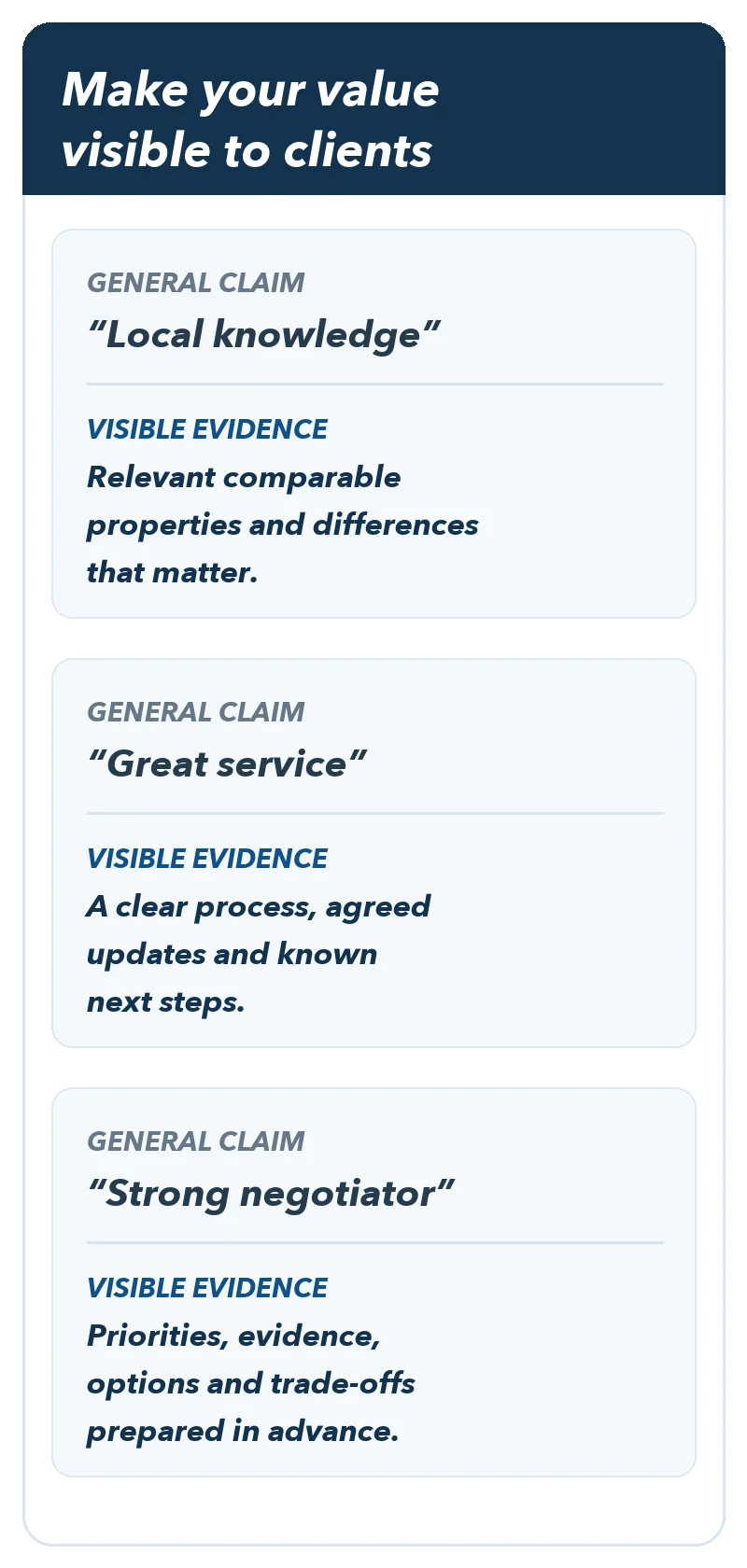
Explain how you select relevant comparable properties and what differences matter. Show how you prepare clients for decisions about price, conditions and timing. Describe your approach to questions and due diligence, including when qualified inspectors, lawyers or other specialists should be involved.
Negotiation deserves the same clarity. Help clients understand how you establish their priorities, prepare with evidence and discuss trade-offs. Avoid promising a particular saving or outcome.
You can demonstrate this through a useful article, a short video or a sample process. Any client example should be accurate, shared with permission and clear about what actually happened. The aim is to make your judgement and preparation easier to understand before someone hires you.
Connect each promise to a reliable process
Exceeding expectations starts with understanding what the client expects. Agree how you will communicate, what happens next and who is responsible for each step.
Consider the experience from the client’s perspective. Do they leave the first conversation knowing the next steps? Do updates arrive when promised? When an issue emerges, do they understand their options and who can help?
A simple written process can reveal gaps between the service you intend to provide and what the client experiences. Strengthen those gaps before making bigger marketing promises. Consistency gives your claims substance and helps clients describe your value to someone else.
For example, an agreed update schedule gives a client a concrete expectation. A clear explanation of the next decision helps them prepare their questions. These are modest commitments, but they are observable. Ask clients which parts of the experience helped most, then use that feedback to improve how you work.
Give your value proposition a practical test
Complete this sentence without using “experienced,” “trusted” or “personal service”:
“Clients choose me because I help them ______, and I demonstrate that by ______.”
If the answer could describe almost any realtor, keep working on it. Name a meaningful client need, explain your contribution and identify evidence that supports it.
For a fuller way to draft and test that statement, see my guide to writing a clear value proposition. Use its need, offer and evidence prompts with your own client situations rather than borrowing generic claims.
Then review your website, social posts and first conversation with a prospective client. Do they communicate the same value? Could someone understand your approach without already knowing you?
Choose one improvement you can make this week. Perhaps it is a clearer explanation of your buying process, a more useful discovery conversation or an example showing how you help clients assess their options.
A short proof check before you publish
- Which client decision does this example help clarify?
- What evidence can you show without sharing a client’s private information?
- What limits or trade-offs should a client understand?
- Can you deliver this consistently, not just in one strong example?
Keep only the claims you can explain and support. The exercise can reveal whether the next improvement belongs in your marketing, your client process or both.
Measure the conversations your marketing creates
Views and recognition are useful, but they only tell part of the story. Look at whether the right people are engaging, visiting your website and asking about working with you.
Record the questions prospective clients ask. Are they starting to recognise the particular value you bring? Are your enquiries better aligned with the people you can help? Those conversations can guide your next improvement.
The opportunity is to help people recognise the value of choosing the right guidance for a major purchase. That requires a clear message and a client experience that supports it.
If you’re a Vancouver realtor reviewing how you attract clients and demonstrate your value, let’s have a conversation about your positioning, your client experience and the next practical steps for your business.