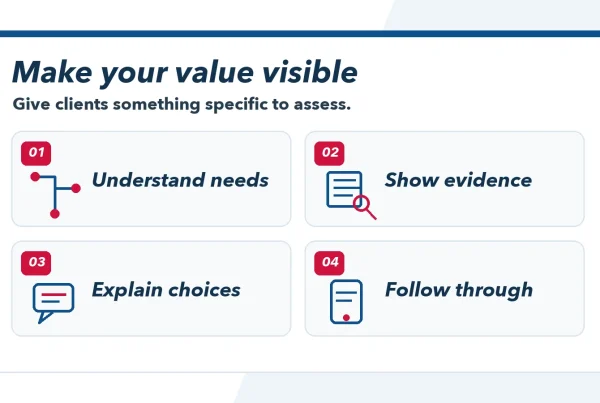

A value proposition explains who an offer is for, what useful difference it is intended to make and why a customer should consider it. It should make the service easier to understand—not promise results the business cannot substantiate.
You do not need a clever slogan to begin. Start with customer evidence and a plain explanation of the work you actually provide. A short headline can introduce the offer, with supporting detail explaining scope, proof and conditions.
Separate the value proposition from the slogan
A mission statement describes an organization’s purpose. A slogan is a memorable expression used in communication. A value proposition focuses on the customer and the offer. They can support one another, but a catchy phrase rarely answers all a buyer’s questions.
There is no mandatory sentence count. Use enough detail to be clear, and revise the proposition when the customer need or service changes.
Start with a specific customer situation
Describe the problem in terms a customer would recognize. “Businesses that want success” is too broad to guide a useful offer. “Small service teams whose project updates are scattered across different systems” is more specific.
Use interviews, actual enquiries and delivery experience to test your understanding. Distinguish a customer’s stated concern from an assumption about their motives. Do not infer sensitive personal information or invent fears to make the message more persuasive.
Explain the offer and its limits
State what the customer receives and how it relates to the problem. A feature describes the service; the benefit explains why that feature may matter. Both can be useful when connected accurately.
For example, a scheduled review meeting is a feature. A clearer opportunity to resolve open project questions is its intended purpose. It would be misleading to turn that into a guaranteed reduction in costs without supporting evidence.
Clarify prerequisites, exclusions and responsibilities. A clear limitation can help a prospective customer decide more confidently than a broad promise to handle everything.
Use a working draft, not a formula
Try completing these prompts:
- We work with a defined type of customer in a particular situation.
- We provide a specific service or product.
- It is designed to address a clearly described need.
- The relevant reason to consider us is something we can support with evidence.
- The next step lets both sides assess fit.
These are drafting prompts, not a validated template or a requirement to claim uniqueness. A relevant, supportable difference is more useful than an invented “world’s best” claim.
Before and after: a hypothetical service offer
Vague: “We deliver innovative solutions that transform your business.”
More concrete: “We help small service teams document their project handoffs, with a working process and staff walkthrough agreed within the project scope.”
The second version tells a buyer more about the work. It would still need details about suitability, deliverables, timing, price and evidence. This is an illustrative copy example, not an offer from Coaching Success or a client result.
Use the Value Proposition Canvas thoughtfully
Strategyzer’s Value Proposition Canvas connects a customer profile—jobs, pains and gains—with a value map describing products and services, pain relievers and gain creators. It is a tool for organizing and testing assumptions about customer needs and the offer.
A completed canvas is not proof of demand. Mark which statements are supported by evidence and which still need investigation. Do not fill every section with guesses simply to make the page look complete.
Test understanding before celebrating conversion
Ask suitable prospective customers to explain what they think the offer includes, who it is for and what remains unclear. Their words can reveal ambiguity that internal discussion missed.
Then review actual enquiries and delivery experience. Are people arriving with accurate expectations? Where do they discover a mismatch? A high click count does not necessarily mean the offer is understood or commercially viable.
If you compare versions of a message, define the question, audience and outcome measure in advance and use an appropriate test design. Small or inconsistent samples can mislead. Time on a page or bounce rate alone cannot tell you why someone responded as they did.
Keep claims aligned with delivery
Check that website copy, proposals and conversations describe the same service. Use customer feedback to refine the message, but also consider whether the offer itself needs to change. Copy cannot repair a service the business cannot deliver.
Coaching can help you examine the choices behind your offer and the conversations needed to clarify it. Copywriting, research and marketing implementation require their own agreed scope.
Book a free 15-minute fit call to discuss whether coaching is appropriate, or apply for two weeks of free coaching. Joel personally reviews applications; acceptance is not guaranteed.