
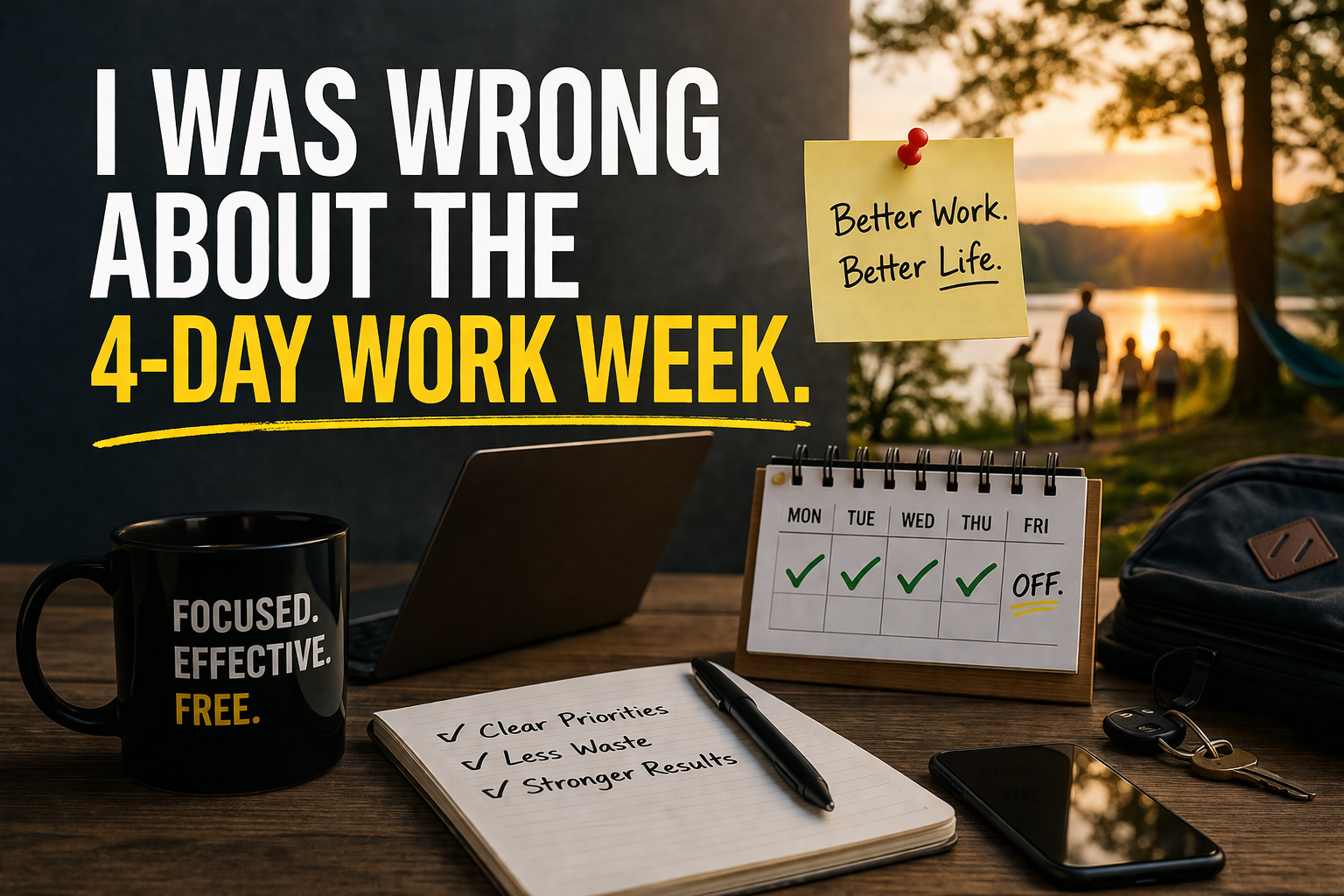
I used to think the 4-day work week was a nice idea for people who didn’t have to run anything.
It sounded good in a panel discussion. It looked great in a headline. In the real world, I expected it to fall apart the second it met deadlines, client expectations, staffing gaps, and the general messiness of operating a business.
My view was simple: if people work less, they’ll get less done.
That felt obvious.
And it turns out I was wrong.
Not because every company can flip a switch and give people Fridays off. Not because every job fits neatly into a 32-hour week. And not because all the loudest advocates are right about everything.
I was wrong because I misunderstood what the 4-day work week is actually testing.
It’s not testing whether people can “do five days of work in four.”
For me, it raises a useful question: which parts of the week genuinely contribute to the work we need to deliver?
That’s a very different question.
And once I started looking at it that way, my whole view changed.
The Mistake I Was Making
Like a lot of people, I was treating the five-day work week as if it were neutral. Standard. Rational. Just the way serious work gets done.
But the more attention I paid, the harder it was to defend.
A large portion of the modern workweek is not focused on valuable, high-leverage work. It’s meetings nobody needed. Updates nobody reads. Slack messages that create more Slack messages. Approval chains that exist because nobody has had the nerve to simplify them. Status theatre. Calendar clutter—busywork with good branding.
Some teams face more essential work than their staffing can support. Others also carry avoidable friction.
Those are different problems, and reducing hours is not a substitute for adequate staffing.
That’s the part I missed.
I assumed the five-day work week reflected actual necessity.
In many cases, it reflects habit.
And habits are easy to confuse with business logic when everyone has been following them long enough.
Why I Changed My Mind
What changed my mind wasn’t a slogan. It was seeing the argument underneath the argument.
The real case for the 4-day work week is not “people want more free time,” even though of course they do.
The real case is this:
When you reduce time, you are forced to confront waste.
That’s where the model gets interesting.
A shorter week puts pressure on everything that has been allowed to bloat inside a normal one. Meetings have to justify themselves. Priorities have to get clearer. Managers have to become more disciplined. Teams have to get better at handoffs, communication, and decision-making. Work that has been limping along on inertia finally gets questioned.
And once that starts happening, you see something uncomfortable:
A lot of what filled a normal workweek never helped much to begin with.
That’s why I don’t see the 4-day work week as a perk anymore.
I see it as an operating model.
The 4-Day Work Week Is Not Soft. It’s Demanding.
This is one of the biggest shifts in how I think about it.
I used to hear “4-day work week” and think: lighter, easier, looser.
Now I hear it and think: tighter, sharper, better run.
Because a company that can make a 4-day work week work usually has to get serious about things many companies avoid:
Clear priorities
A team cannot thrive on a shorter week if everything is still urgent.
Once time gets tighter, leaders have to decide what actually matters. Not what sounds important. Not what has always been done. What genuinely moves the business forward.
That kind of clarity is rare. And valuable.
Better meetings
A lot of organizations say they care about productivity, then spend half the week proving otherwise.
The 4-day work week exposes bad meeting culture fast. If the week is shorter, no one has patience for recurring calls with vague agendas, oversized attendee lists, and no decisions at the end.
Good.
That should have been true anyway.
Stronger management
This is where the whole thing gets real.
The 4-day work week rewards managers who know how to lead around outcomes rather than presence. It rewards businesses that know the difference between visibility and contribution.
The model raises legitimate questions about management, coverage, cost and the nature of the work. Scepticism is not evidence of poor leadership.
Real trust
A shorter week only works in environments where adults are treated like adults.
That means less babysitting. Less performative responsiveness. Less obsession with whether someone looked “busy enough” on a Thursday afternoon.
If a company needs constant visual proof of effort to feel safe, the problem is probably bigger than the calendar.
The Objections Deserve a Serious Answer
To be fair, the arguments against the 4-day work week are not crazy. I believed them for a reason.
They sound practical. Responsible, even.
Some point to avoidable habits; others identify genuine constraints that a shorter week may not resolve.
“You can’t do five days of work in four.”
True.
But that assumes all five days were full of essential work.
That needs to be established in your own operation, not assumed.
Most companies are not trying to compress five clean, efficient, high-output days into four. They’re trying to remove the friction, clutter, and ritual that made the five-day version so inefficient in the first place.
That’s not fantasy. That’s management.
“This only works in certain industries.”
Sure, some environments will find it easier to adopt than others. A software company and a hospital do not face the same constraints.
But this objection often gets used as a conversation-ending cliché.
The fact that implementation looks different across different businesses does not mean the idea has no value. It means adults have to design for reality. Coverage can be staggered. Schedules can rotate. Teams can pilot different structures. Not every four-day model looks the same, and it shouldn’t.
That’s not a weakness. That’s just what real operations look like.
“Clients need coverage.”
Of course they do.
Coverage is a real requirement. A different schedule may need more staff or may not be viable within the available resources.
Ask clients what access and response times they require, and review contractual commitments. Do not assume that a schedule change will be invisible or acceptable to them.
A lot of leaders treat “the client needs us” as the end of the discussion.
Usually, it’s the beginning.
What the 4-Day Work Week Actually Reveals
This is the part that really changed my mind.
The 4-day work week is valuable not only because it gives people more rest, more family time, and more breathing room — though that matters a lot.
It’s valuable because it reveals how a company works.
Before deciding, examine whether any of these issues are present:
- your processes are too messy
- your meetings are eating the week
- your managers are running on reaction instead of design
- your staffing model is fragile
- your culture rewards busyness over contribution
- your systems depend on people being “always on” to compensate for bad structure
That’s useful information.
A shorter week becomes a mirror.
An unsuitable result is also useful: keeping the existing schedule can be a responsible decision.
Where Supporters Get It Wrong
That said, I still think some people oversell this.
The 4-day work week is not magic. It is not a morale trick. It is not “everyone gets Friday off, and somehow productivity goes up because vibes.”
That framing weakens the argument.
A shorter week only works when the work itself changes.
Please don’t just shave a day off the calendar and leave the expectations unchanged. That’s not redesign. That’s compression. And compression is exactly how you turn a good idea into a stressful one.
If the same number of meetings stay on the calendar, the same volume of low-value work survives, and the same response expectations remain in place, then yes — the 4-day work week will feel chaotic.
That doesn’t prove the idea is broken.
It may show that the design, resources or model need reconsideration.
How I’d Approach a 4-Day Work Week Now
I wouldn’t start with ideology. I’d start with a pilot.
Not a branding exercise. A real pilot.
Agree participation, pay and hours, service coverage, a baseline, review dates and conditions for stopping the trial. Obtain qualified employment and scheduling advice before changing arrangements. Include employee feedback without requiring disclosure of private health information. Pick a team where outcomes can be measured. Define success before you begin. Look at output, response times, client experience, employee stress, retention risk, and operational bottlenecks. Cut unnecessary meetings before cutting hours. Simplify approvals. Tighten priorities. Protect focus time. See what breaks. Then fix what actually matters.
That’s the approach.
Not endless debate.
Not vague enthusiasm.
Not “someday.”
A serious experiment tells you more than a hundred opinions.
Why I’m Now in Favour of the 4-Day Work Week
I used to think the 4-day work week was mostly about comfort.
Now I think it’s about quality.
Quality of work.
Quality of management.
Quality of life.
Quality of attention.
And in a world where so many people are burned out, distracted, over-meetinged, and permanently behind, that matters.
The strongest argument for the 4-day work week is not that people want to work less.
It’s that most organizations would be better off if they stopped pretending that more time automatically means more value.
That assumption has survived for a long time because it feels safe. Traditional. Familiar.
But familiar systems can still be wasteful systems.
That’s what I got wrong.
I thought the five-day week was the serious option and the 4-day week was the indulgent one.
Now I think the opposite is often closer to the truth.
The 4-day work week is not unserious.
In many cases, it is the more disciplined model.
It demands better decisions.
Better boundaries.
Better processes.
Better leadership.
And that’s exactly why it’s worth taking seriously.
FAQs About the 4-Day Work Week
Does a 4-day work week actually work?
It can, but not by accident. The companies that make it work usually redesign how work gets done instead of simply squeezing the same chaos into fewer days. That means fewer unnecessary meetings, clearer priorities, better communication, and stronger management.
Is a 4-day work week the same as working four 10-hour days?
No. Those are different models. A compressed schedule keeps the total hours the same but spreads them differently. A reduced-hours model cuts total working hours. Be explicit about hours, pay, benefits and coverage rather than relying on the label alone.
Can every business adopt a 4-day work week?
No model works the same way everywhere. But that doesn’t mean the idea is only for one kind of company. Different businesses can test different versions depending on staffing, client needs, workflow, and coverage requirements.
Won’t clients get frustrated?
They might. Ask about service needs, agree coverage and monitor complaints or delays. Good intentions do not guarantee an acceptable client experience.
What’s the biggest mistake companies make?
Treating the 4-day work week like an announcement instead of a redesign project. If expectations stay the same and the work stays messy, a shorter week becomes stressful fast.
Why does this topic trigger such strong opinions?
Because it challenges one of the oldest assumptions in business: that longer time equals greater seriousness. For many leaders, that assumption is as much emotional as it is operational.
Final Thought
I was wrong about the 4-day work week because I was defending the five-day work week without questioning what it was actually producing.
That’s the trap.
We inherit a model, call it normal, and then mistake it for necessary.
But a lot of modern work is overdue for a redesign.
The 4-day work week doesn’t solve everything.
It does ask a better question:
What would happen if we stopped organizing work around habit and started organizing it around what actually works?
That’s the question more leaders should be asking.
Explore the leadership questions
Book a free 15-minute fit call to discuss whether coaching could help you examine priorities and implementation. Coaching does not replace employment, safety or operational specialist advice. You can also apply for two weeks of free coaching; applications are reviewed personally and acceptance is not guaranteed.