

“We need more leads” can be a reasonable conclusion. It can also be an expensive guess. A Vancouver service business may have plenty of enquiries while suitable opportunities stall between the first conversation, a proposal and a decision. Another campaign creates activity, but the same sales problem returns. A sales pipeline review can test that first diagnosis.
A useful sales pipeline review starts with the presenting problem, tests what is happening at each stage and helps the owner design one practical response. More activity may be needed. First, establish where that activity would make a difference.
This 30-day review is designed for owner-led consultancies, agencies, trades and professional service businesses across Greater Vancouver. It includes a dated worksheet, a hypothetical example and one monthly corrective test.
What a sales pipeline review should answer
A full pipeline is a list of possibilities. A dependable pipeline needs evidence about fit, progress, timing and the business’s ability to deliver.
BDC’s sales-process guidance recommends mapping the steps and responsibilities, defining useful measures and reviewing movement through the process. Its sales-funnel guidance also emphasizes reflecting how customers actually buy. Those are useful foundations; this review turns them into a specific monthly management exercise.
If your basic stages and responsibilities are still unclear, begin with my Sales Foundations guide from enquiry to delivery. Here, the narrower question is: which stage deserves a closer look this month, and what evidence would justify changing it?
1. Define stages by something that actually happened
“Interested” and “likely to close” mean different things to different people. Use observable events and write down what qualifies an opportunity to enter each stage. A simple service-business sequence might be:
- Enquiry received: a genuine request about your service, with duplicates and spam removed.
- Fit confirmed: the stated need, service scope and practical buying conditions have been checked.
- Discovery completed: the buyer’s problem, intended outcome and decision process have been discussed.
- Proposal delivered: a relevant scope, price and delivery assumptions have been provided.
- Decision recorded: won, declined or deferred, with the reason where appropriately known.
Adapt these stages to your business. A maintenance booking and a multi-month consulting engagement need different levels of detail. Keep a separate “still open” status; silence does not establish a loss or permission to keep contacting someone.
2. Match stage cohorts in your sales pipeline review
Dividing this month’s wins by this month’s new enquiries can mix unrelated opportunities. Some wins may have started months earlier, while yesterday’s enquiry has barely had time to progress.
For a stage-level comparison, choose a group that entered the same stage during a defined period. Then give each opportunity the same observation window from its own entry date.
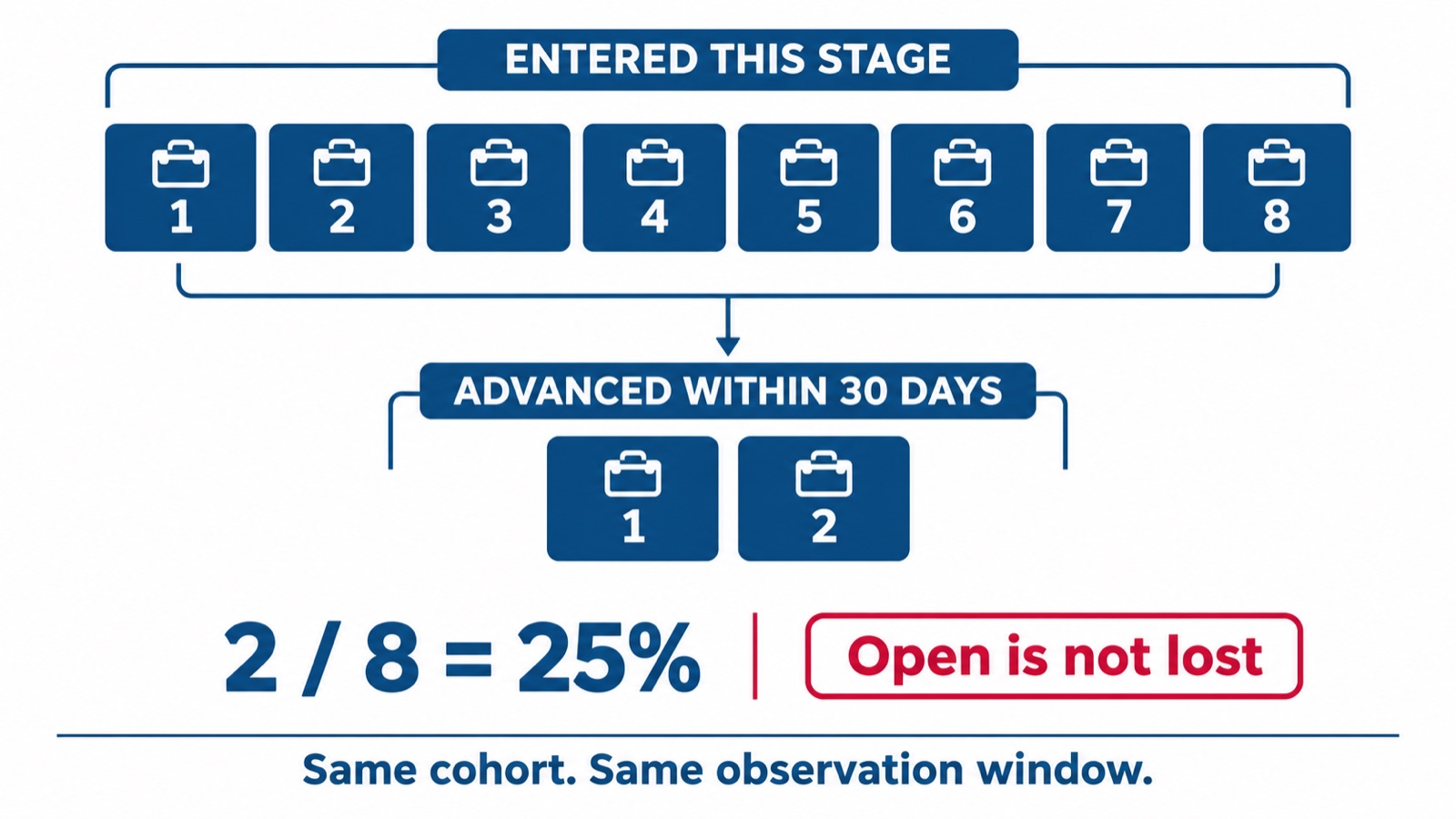
30-day stage progression = opportunities from that group reaching the specified next stage within 30 days ÷ all opportunities in that stage-entry group × 100.
For example, use opportunities entering a stage from September 17 to October 16, 2026. By November 15, every opportunity has had 30 days of observation. Record progress within each opportunity’s own first 30 days, rather than counting every eventual advance up to the review date.
Thirty days is the review convention used here, not a universal sales-cycle standard. If your normal buying cycle is longer, use a suitable longer window consistently and label recent opportunities as not yet mature enough to compare. Keep a current pipeline snapshot alongside the historical measure.
Count each opportunity once per stage-entry group. Record duplicates, reopened opportunities and missing dates separately. If no opportunities entered a stage, report the rate as not applicable; if dates are missing, report what is unknown. Neither situation is a zero-percent result.
3. Use the dated sales pipeline review worksheet
Copy these fields into a working document or your CRM. The dates below are a completed-period example for a review on November 16, 2026. Shift them forward for your next review.
| Review field | What to record |
|---|---|
| Business segment | One service line, buyer type and source where the sample permits a useful comparison. |
| Current activity period | October 17–November 15, 2026: new enquiries, stage movements and current open opportunities. These are activity counts, not automatically conversion rates. |
| Stage-entry cohort | September 17–October 16, 2026, assessed separately for each starting stage. |
| Observation rule | First 30 days after each opportunity entered that stage; all windows complete by November 15. |
| Matched counts | Number entering; number advancing within the window; number declined or deferred; number still open at day 30. |
| Evidence and timing | Entry dates, agreed next steps, response and proposal timing, and appropriately recorded buyer feedback. |
| Possible explanation | One hypothesis supported by records, plus competing explanations and missing evidence. |
| Correction and owner | One practical change, a named owner, its start date and the prospects to whom it applies. |
| Review date | First implementation review: December 18, 2026. Assess outcome cohorts later if their observation windows are incomplete. |
For a solo owner, the same document works without a team meeting. Reserve a short review with your records open. Avoid copying personal prospect details into a broadly shared worksheet; opportunity references and aggregated patterns may be enough.
4. Read the pattern before choosing the remedy
A low rate identifies a question. It does not prove the cause. Examine a few underlying records and compare like services, sources and buying cycles before deciding what to change.
- Few enquiries fit: check targeting, service descriptions and qualification criteria before purchasing more traffic.
- Suitable enquiries stall before discovery: examine response timing, booking friction and whether the next step was useful to the buyer.
- Discovery rarely reaches a proposal: check whether the problem, scope, budget discussion or decision process remained unresolved.
- Proposals remain undecided: review scope clarity, value, timing, buyer approval requirements and any agreed decision conversation.
- Wins strain delivery: bring sales and operations together. Review cash and delivery capacity before accepting larger commitments.
Small samples can swing sharply. Compare counts as well as percentages and avoid treating the lowest percentage as the automatic priority. A stage may appropriately exclude unsuitable work. Consider commercial importance, time, delivery capacity and the evidence available.
A hypothetical service-business example
The following figures are invented to illustrate the method; they are not client results or Vancouver benchmarks. Imagine a consulting firm reviewing the September 17–October 16 stage-entry groups on November 16:
- Enquiry to confirmed fit: 24 of 40 enquiries progressed within 30 days: 60%.
- Confirmed fit to discovery: 12 of 20 opportunities progressed: 60%.
- Discovery to proposal: 8 of 10 progressed: 80%.
- Proposal to won: 2 of 8 progressed: 25%. Of the other six, two were declined and four were still open at day 30.
These are separate stage-entry groups, not one chain of 40 people becoming 20, then 10, then eight. An opportunity may have entered an earlier stage before the cohort period began. Each numerator contains only opportunities from its own denominator.
The owner should not call the proposal result a 75% loss rate: half that proposal group was still open. A win rate among the four decided proposals would be 2 ÷ 4, or 50%, which answers a different question and excludes unresolved opportunities.
The records show that three of the four open proposals had no agreed decision conversation. That makes the handoff worth investigating. It does not prove that a meeting would have won the work; procurement delays, weak fit or an unclear business case remain possible.
5. Design one corrective test for the next month
For that hypothetical firm, the owner could test offering a short proposal-review conversation at a time the buyer agrees is useful. The aim is to make scope, questions and the decision process clearer.
- Test period: November 19–December 18, 2026.
- Group: every suitable new proposal in one defined service line.
- Owner: the person accountable for that service’s sales process.
- Leading measure: proposals with an explicitly agreed next step ÷ all proposals in the test group. Record “buyer declined” separately.
- Outcome: proposal progression within 30 days, with declined, deferred and still-open counts visible.
- Guardrails: buyer preferences, suitability, delivery commitments and time spent on the process.
On December 18, review whether the change was implemented and useful. The final proposal entering that day will not complete its 30-day window until January 17, 2027, so review the full outcome cohort on January 18. Do not claim a result while half the group is still waiting.

Keep follow-up useful and consent-aware
A CRM reminder is an internal task, not permission to send a message. Record what contact the buyer agreed to, through which channel and when. Respect refusals and withdrawals; avoid automatically enrolling every enquiry in a promotional sequence.
The CRTC’s CASL guidance identifies consent, sender identification and an unsubscribe mechanism as the main requirements for commercial electronic messages. The applicable rules and exceptions depend on the circumstances. Check your consent records and approved process; obtain qualified advice where the legal position is unclear.
Turn the sales pipeline review into a decision
The useful output is a better-supported management decision: what appears to be obstructing suitable opportunities, what evidence would challenge that explanation, and what one response you will test.
I can help you examine the presenting problem, question the diagnosis and design a practical change through business coaching focused on your priorities. You remain responsible for the business decisions and implementation, with my support.
Which stage would you investigate first, and what evidence would change your mind about its cause? Bring that question to a free 15-minute Fit & Priorities Call. Start with the short business and location questions; the next step may be booking options or manual review. The call explores fit for coaching rather than providing a complete pipeline assessment.