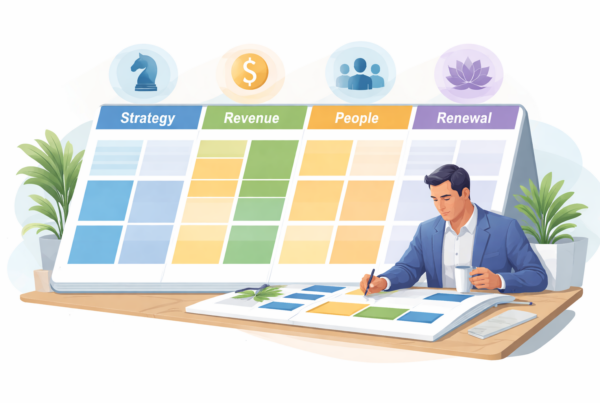

A business coach helps an owner turn goals into decisions, actions and measurable progress. The coach brings an outside perspective, asks the questions that day-to-day pressure can obscure, helps create a practical plan and provides accountability for following through.
The work is not about handing control of your company to somebody else. Coaching can help you examine decisions, build your own capability and address recurring operational problems. Results depend on the situation and the work undertaken.
What a business coach actually helps with
The exact priorities depend on the company, but most coaching engagements connect the owner’s ambitions to the systems and habits required to achieve them. That can include:
- Clarifying direction: defining what success means, choosing priorities and deciding what not to pursue.
- Planning: translating longer-term goals into a focused 90-day plan with owners, deadlines and measures.
- Financial understanding: improving visibility into revenue, margins, cash flow and the numbers that guide decisions.
- Sales and marketing: examining the customer journey, lead generation, conversion and retention.
- People and leadership: strengthening delegation, communication, roles, hiring and performance conversations.
- Systems: identifying recurring work that needs a documented, repeatable process.
- Accountability: reviewing commitments, learning from results and maintaining momentum.
A coach may also help an owner prepare for a major transition: scaling, adding a leadership layer, resolving a partnership issue or making the business less reliant on the founder.
What a business coach does not do
Coaching is often confused with consulting and mentoring. They can overlap, but the centre of each relationship is different.
| Support | Primary contribution | Best used when |
|---|---|---|
| Business coach | Questions, structure, challenge and accountability | You need clearer decisions and consistent execution |
| Consultant | Specialist analysis and recommendations | You need expertise or a defined solution delivered |
| Mentor | Experience and advice from a similar path | You want perspective from someone who has been there |
A coach should not make every decision for you, guarantee a result or replace legal, accounting, medical or mental-health professionals. When specialist advice is needed, the responsible step is to involve the right qualified adviser.
What happens in a coaching engagement?
- Discovery and clarification. You discuss the business, the owner’s goals, current performance and the constraints getting in the way.
- Focus. Together you identify the few priorities likely to make the greatest difference.
- Plan. Broad intentions become specific actions, measures, responsibilities and dates.
- Regular review. Meetings examine what happened, what was learned and which decision comes next.
- Capability building. Over time, the owner and team develop stronger planning, leadership and problem-solving habits.
The rhythm might be one-to-one or group-based. The important point is that each conversation leads back to the real business and an agreed next action. You can compare Joel’s coaching and workshop options on the Ways to Work With Joel page.
When is business coaching most useful?
Coaching can help when the business is growing but feels increasingly difficult to manage; when performance has plateaued; when too many decisions still depend on the owner; or when there is plenty of activity without enough progress on the priorities that matter.
It is also useful when an owner knows what should happen but struggles to create space, sequence the work or maintain accountability. Coaching cannot create time or resources on the owner’s behalf. It can help examine obstacles, competing priorities and realistic next actions.
How should progress be measured?
The measures should match the purpose of the engagement. Financial results matter, but they are rarely the only evidence. Depending on the goal, progress might include:
- revenue, gross margin, cash flow or recurring revenue;
- lead conversion, customer retention or average transaction value;
- fewer hours spent firefighting and more time on strategic work;
- clearer roles, stronger delegation and fewer decisions bottlenecked with the owner;
- completion of the agreed 90-day priorities;
- improved meeting discipline and accountability across the team.
Agreeing the measures at the start makes the coaching relationship easier to evaluate. Review business outcomes and working practices, including costs, other influences and what has not improved.
How to choose the right business coach
Look beyond chemistry alone. A productive first conversation should help you assess the coach’s experience, process and willingness to challenge you constructively.
- Do they understand owner-led businesses and the stage yours is in?
- Can they explain how coaching sessions lead to action between meetings?
- Will goals and progress be measured?
- Can they distinguish coaching from areas that require specialist advice?
- Are expectations, confidentiality, fees and cancellation terms clear?
- Do you feel able to be candid with them while still expecting respectful challenge?
Joel Zimelstern works with Vancouver business owners who want stronger priorities, systems, leadership and accountability. Learn more about Vancouver business coaching, or use the Free 15-minute fit call to discuss the situation before deciding whether coaching is the right fit.
Frequently asked questions
Will a business coach tell me exactly what to do?
Sometimes a coach will share tools, experience or a direct observation. The deeper value is helping you examine assumptions, make a sound decision and take ownership of the action.
How quickly should I expect results?
Some decisions can change immediately; meaningful business results usually depend on consistent execution over time. Be cautious of guaranteed outcomes or promises of effortless transformation.
Is coaching confidential?
The scope and confidentiality expectations should be agreed before work begins, particularly where a sponsor or leadership team is involved. You can also review Coaching Success’s privacy policy.
Is business coaching worth the cost?
It can be when the objective is clear, the owner is prepared to act and progress is measured. The sensible question is whether the decisions and behaviour changes produced by the engagement create value greater than its cost.
Ready to get out of the day-to-day and focus on what matters?
Use a free 15-minute fit call to discuss the challenge and whether working together may fit.
Book a Free 15-minute fit call
You can also apply for two weeks of free coaching. Applications are reviewed manually; acceptance and particular results are not guaranteed.