

AI business bottlenecks can remain even when your team produces work faster. Your customer may still wait for the result.
The proposal may still wait for your approval. The new customer may still wait for onboarding. The analysis may arrive in minutes, then sit for days because nobody knows who can make the decision.
For business owners, the question is where the time saved actually goes.
What Clio’s latest move makes worth examining
On September 30, 2026, Greater Vancouver-based Clio announced its acquisition of Learned Hand, an AI company developing tools for judges and courts. Clio describes this as its first direct expansion into the judiciary. Its Greater Vancouver headquarters are in Burnaby.
In the announcement, founder and CEO Jack Newton says that when legal work accelerates but court capacity remains constrained, the bottleneck simply shifts to the courts
.
That is Clio’s explanation of the opportunity. The acquisition is not proof that court turnaround times have improved. For me, the useful business lesson is the distinction between speeding up an activity and improving the system that activity belongs to.
You do not need to run a legal business to recognise the pattern. It can appear anywhere work passes from one person, team or decision to another.
A quicker quote can still produce a slower customer experience
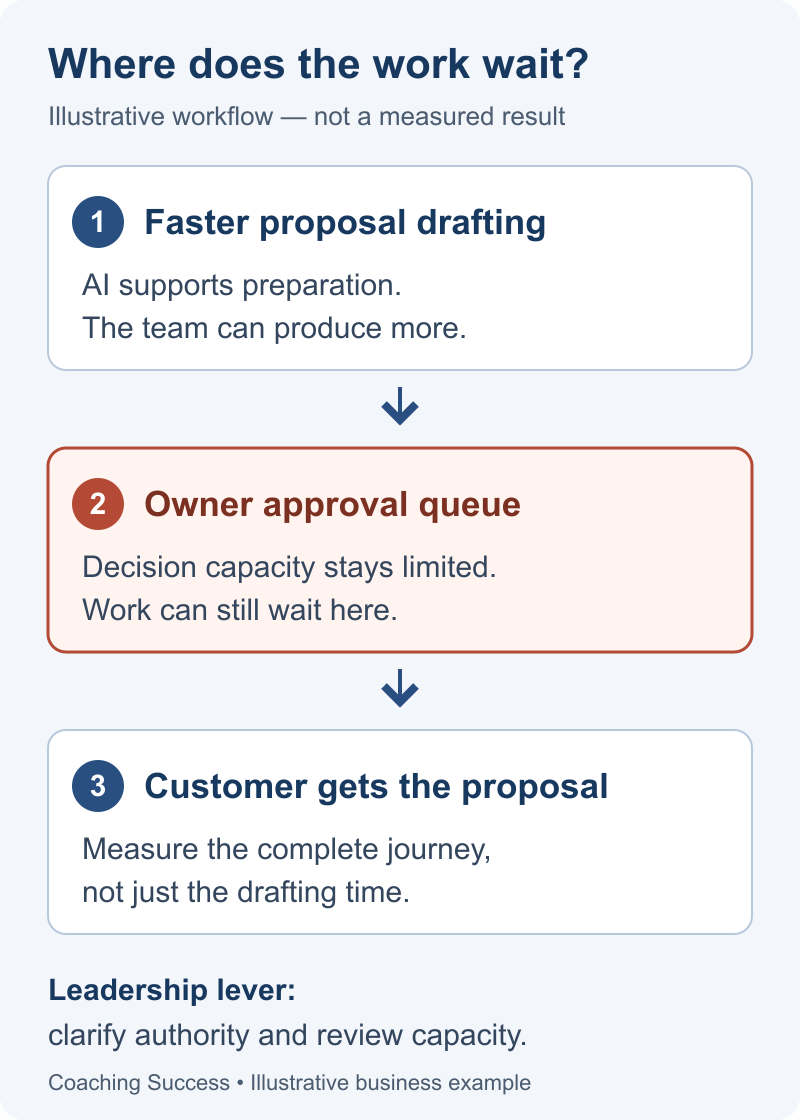
Consider a hypothetical professional-services firm. An AI-assisted process reduces the effort needed to prepare a proposal. The team can now prepare more proposals each week.
Every proposal still requires the owner’s approval, however. The owner reviews them between client meetings, without a regular review window or clear rules for which proposals the team can approve.
The team celebrates faster preparation. Meanwhile, a larger queue builds in the owner’s inbox. Customers still wait, staff chase approvals, and revisions make the work harder to track.
The next improvement may be clearer decision rights: who can approve a standard proposal, what requires an exception, and when an exception receives an answer. More drafting capacity alone will not resolve those questions.
If this feels familiar, the wider AI productivity playbook for Vancouver leaders explores how leadership and operating habits can affect the value of your investment.
AI business bottlenecks: follow the next two steps
Before expanding an AI process, choose one piece of work that matters to a customer and follow it beyond the task you are automating. A short team conversation can expose more than a long list of software features.
- Name the finished customer outcome. “More proposals drafted” describes activity. “An accurate proposal received and understood by the customer” describes a useful result. Be specific about the finish line.
- Map the next two steps. Who receives the output? What must happen before the customer benefits? Include approval, checking and handover time, rather than only the time spent producing the first draft.
- Find where work waits. Look for an inbox, review queue, missing information, limited delivery capacity or a decision repeatedly referred upwards. Ask the people doing the work what stops them moving it forward.
- Give the constraint an owner. Name who can make the decision, the authority they have, and the exceptions that need escalation. An accountable owner also needs enough time and capacity to act.
- Test a small change and review the result. Compare the complete customer journey before and after. Keep a quality check, record rework, and ask whether the change improves delivery without simply transferring effort to someone else.
For example, imagine marketing generates more suitable enquiries, but the onboarding team can only start a limited number of customers each week. The useful conversation may concern scheduling, readiness criteria and available capacity. Increasing enquiries again before addressing that constraint could increase waiting and disappointment.
Measure the result beyond the faster task
To assess AI business bottlenecks, use measures your team can observe consistently: end-to-end turnaround time, time waiting for a decision, completed customer outcomes, and the proportion of work needing correction. Where your records support it, examine delivery cost and margin as well.
A task-time saving is still useful evidence. Put it beside the wider measures, with a clear period and comparable workload. Treat unavailable information as unknown. Avoid declaring that AI improved profitability merely because the team produced more output.
There is also a judgement question. Who remains responsible for accuracy, confidentiality and the final decision? Faster preparation does not remove the need to decide which work requires human review.
One question for your next team meeting
If we made this activity twice as fast tomorrow, where would the work wait next?
Then agree one manageable experiment at that point in the workflow. The aim is a customer outcome your business can deliver reliably, with the people and capacity it actually has.
If you would value an outside perspective on that constraint, send me a message using the contact form on Coaching Success. We can explore the operating or leadership question that deserves attention first.